RATHER BLACK [SCREEN]
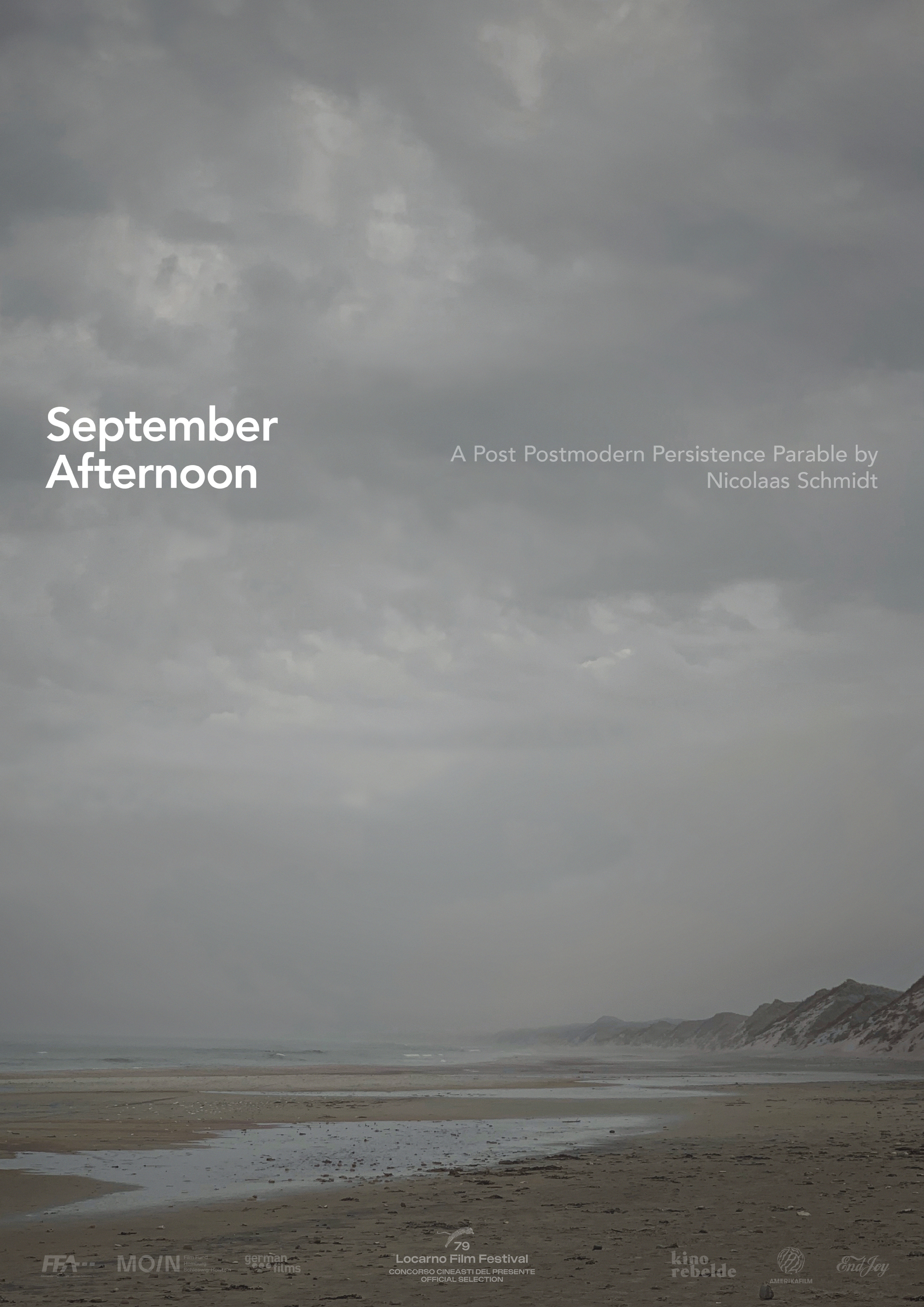
SEPTEMBER AFTERNOON
LINEAR ENDJOY
LIKE HORSES STANDING IN THE RAIN
CINÉMOON
ENDJOY
FIRST TIME
INFLORESCENCE
BELIEVE
FINAL STAGE
36KFRGB SPCL: DMD KIU LIDT*
THE MANIFESTATION OF CAPITALISM
AUTUMN
LEAVING MONOCHROMIA
BREAK
FOREVER
COMPARE
DIE REISE MIT DER EISENBAHN HAT SICH DURCHAUS EIN WENIG GELOHNT
THE NICEST PLACE HE NEVER HAS SEEN
GENTLY GROUND FAST FARE
SENSE+INNOCENCE
OHNE SCHLECHTES GEWISSEN GENIESSEN
NEUSEENLAND
NEXT IN LINE
SEPTEMBER AFTERNOON (Grainy Eyes / Sandy Tears)
2026, 4K DCP, 70', NO DIALOG, 5.1, COLOR, 1,85:1
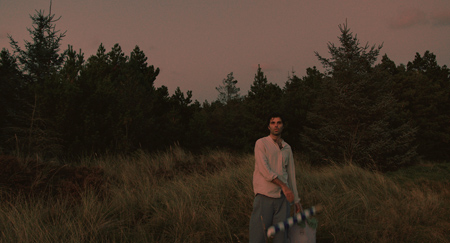
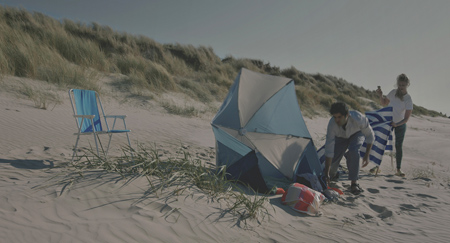
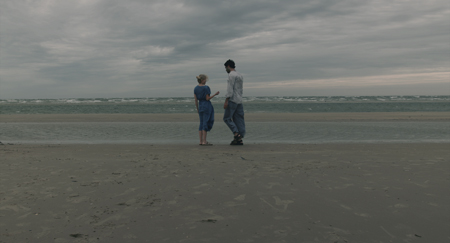
A couple refuses to accept that summer is over. For a last time, the small family heads to the coast with the intention of spending two afternoons together between sand dunes and sea water. The temperatures have long been too cold for sandals and shorts; the blustery autumn wind is no substitute for cosy rays of summer sun.
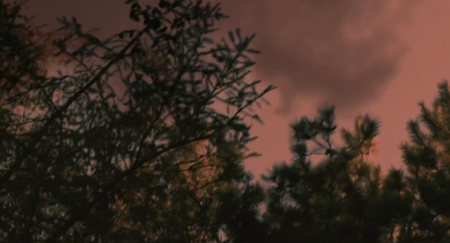
On the way to the beach, they cross paths with a woman they know loosely. Upon arrival, they look in vain for a dune to take shelter from the wind; a small dam is built and defended hard against the tide, an attempt to erect a windbreak is made. These desperate struggles against the encroaching elements are merely a brief interlude before the situation unravels into a disaster of an entirely different magnitude.
A Contemporary Cosmic Catastrophe.
Ein Paar weigert sich zu akzeptieren, dass der Sommer vorbei ist. Ein letztes Mal macht sich die kleine Familie auf den Weg an die Küste, mit der Absicht, zwei Nachmittage gemeinsam zwischen Sanddünen und Meerwasser zu verbringen. Die Temperaturen sind längst zu kalt für Sandalen und Shorts; der stürmische Herbstwind ist kein Ersatz für wärmende Sommer-Sonnenstrahlen. Auf dem Weg zum Strand kreuzt eine flüchtige Bekannte ihren Weg. Am Ziel angekommen, suchen sie vergebens nach einer Düne, die Schutz vor dem Wind bietet; ein kleiner Damm wird errichtet und verbissen gegen die Flut verteidigt, man versucht einen Windschutz aufzubauen. Diese verzweifelten Kämpfe gegen die herannahenden Elemente sind jedoch nur ein kurzes Zwischenspiel, bevor die Situation in eine Katastrophe ganz anderen Ausmaßes mündet.
Eine Contemporary Cosmic Catastrophe.
2026, 4K DCP, 70', NO DIALOG, 5.1, COLOR, 1,85:1
A couple refuses to accept that summer is over. For a last time, the small family heads to the coast with the intention of spending two afternoons together between sand dunes and sea water. The temperatures have long been too cold for sandals and shorts; the blustery autumn wind is no substitute for cosy rays of summer sun.
On the way to the beach, they cross paths with a woman they know loosely. Upon arrival, they look in vain for a dune to take shelter from the wind; a small dam is built and defended hard against the tide, an attempt to erect a windbreak is made. These desperate struggles against the encroaching elements are merely a brief interlude before the situation unravels into a disaster of an entirely different magnitude.
A Contemporary Cosmic Catastrophe.
Ein Paar weigert sich zu akzeptieren, dass der Sommer vorbei ist. Ein letztes Mal macht sich die kleine Familie auf den Weg an die Küste, mit der Absicht, zwei Nachmittage gemeinsam zwischen Sanddünen und Meerwasser zu verbringen. Die Temperaturen sind längst zu kalt für Sandalen und Shorts; der stürmische Herbstwind ist kein Ersatz für wärmende Sommer-Sonnenstrahlen. Auf dem Weg zum Strand kreuzt eine flüchtige Bekannte ihren Weg. Am Ziel angekommen, suchen sie vergebens nach einer Düne, die Schutz vor dem Wind bietet; ein kleiner Damm wird errichtet und verbissen gegen die Flut verteidigt, man versucht einen Windschutz aufzubauen. Diese verzweifelten Kämpfe gegen die herannahenden Elemente sind jedoch nur ein kurzes Zwischenspiel, bevor die Situation in eine Katastrophe ganz anderen Ausmaßes mündet.
Eine Contemporary Cosmic Catastrophe.


PRESS REVIEWS
“Schmidt has crafted a beautiful and hypnotic first feature, one built from repetition, silence, and fleeting sensations. It establishes him as one of the major new directors, and one who can find profound emotion in life’s ordinary rhythms.”
— ICS, John Lynn
“What is most compelling is its resistance to narrative time.”
— Variety, Vedant Srinivas, Matilda Hague
“A unique film language that resists uniformity.”
— The Hollywood Reporter, Georg Szalai
“A film that delights from scene to scene.”
— Frankfurter Rundschau, Daniel Kothenschulte (from German)
“Transforms a devilishly minimalist vignette into an apocalyptic disaster movie - simply astounding. […] The remarkable achievement of Schmidt's direction lies in building such an ambitious film using elements that are anything but conventional narrative: it is a choreographic work of heartbreaking sadness.”
— Le Polyester, Gregory Coutaut (from French)
“Nicolaas Schmidt transforms banal routines into tense, absurd, and unexpectedly high-stakes experiences. […] ‘In an age of arbitrary extraordinariness, plain banality is stimulating as fuck.’ September Afternoon, much like his previous films, effectively validates that premise—turning the simple act of digging a hole in the sand or walking along a beach into something that feels almost life-or-death. Sometimes even more so than when things genuinely spiral out of control.”
— Micropsia, Diego Lerer
“It is conventional to think of a film’s diegesis, its fictional world, as more or less insulated from a filmmaker’s formal or stylistic decisions. But like Godard, Schmidt seems interested in the way that ‘mere’ formal or stylistic decisions are in fact capable of unsettling what we take the diegesis to be.”
— In Review Online, Lawrence Garcia
“A very political element – how to regain agency over the use of your time.”
— Giona A. Nazzaro, Locarno Film Festival (via THR)
“A reality that cannot be grasped […] pushes filmic storytelling to its limits.”
— Critic.de, Leonard Krähmer (from German)
“Schmidt has crafted a beautiful and hypnotic first feature, one built from repetition, silence, and fleeting sensations. It establishes him as one of the major new directors, and one who can find profound emotion in life’s ordinary rhythms.”
— ICS, John Lynn
“What is most compelling is its resistance to narrative time.”
— Variety, Vedant Srinivas, Matilda Hague
“A unique film language that resists uniformity.”
— The Hollywood Reporter, Georg Szalai
“A film that delights from scene to scene.”
— Frankfurter Rundschau, Daniel Kothenschulte (from German)
“Transforms a devilishly minimalist vignette into an apocalyptic disaster movie - simply astounding. […] The remarkable achievement of Schmidt's direction lies in building such an ambitious film using elements that are anything but conventional narrative: it is a choreographic work of heartbreaking sadness.”
— Le Polyester, Gregory Coutaut (from French)
“Nicolaas Schmidt transforms banal routines into tense, absurd, and unexpectedly high-stakes experiences. […] ‘In an age of arbitrary extraordinariness, plain banality is stimulating as fuck.’ September Afternoon, much like his previous films, effectively validates that premise—turning the simple act of digging a hole in the sand or walking along a beach into something that feels almost life-or-death. Sometimes even more so than when things genuinely spiral out of control.”
— Micropsia, Diego Lerer
“It is conventional to think of a film’s diegesis, its fictional world, as more or less insulated from a filmmaker’s formal or stylistic decisions. But like Godard, Schmidt seems interested in the way that ‘mere’ formal or stylistic decisions are in fact capable of unsettling what we take the diegesis to be.”
— In Review Online, Lawrence Garcia
“A very political element – how to regain agency over the use of your time.”
— Giona A. Nazzaro, Locarno Film Festival (via THR)
“A reality that cannot be grasped […] pushes filmic storytelling to its limits.”
— Critic.de, Leonard Krähmer (from German)
DATA
World Sales: Kino Rebelde
Production: Amerikafilm, Maximilian Haslberger, Balthasar Busmann
Realisation: Eternaltrendtowardsgrey, Nicolaas Schmidt
Funding: BKM / FFA Filmförderungsanstalt, MOIN Filmförderung Hamburg Schleswig-Holstein
Script / Director: Nicolaas Schmidt
Cast: Hedi Großmann, Katharina Großmann, Amin Motallebzadeh, Ada Kurzhöfer
Dop: Thomas Oswald
Editing: Nicolaas Schmidt
Set- / Costume Design: Anna Grath
Compositing / VFX: Pavlo Dalakishvili, Tim Liebe
Sound Design: Iason Roumkos, Nicolaas Schmidt
Color Grading / Sound Mix: Studio Musolff, Roland Musolff
Graphic Design: Nils Küppers, Nicolaas Schmidt
Dramaturgic Advisor: Birgit Glombiza
Casting: Anne Döring
Research: Doppelte Unendlichkeit
World Sales: Kino Rebelde
Production: Amerikafilm, Maximilian Haslberger, Balthasar Busmann
Realisation: Eternaltrendtowardsgrey, Nicolaas Schmidt
Funding: BKM / FFA Filmförderungsanstalt, MOIN Filmförderung Hamburg Schleswig-Holstein
Script / Director: Nicolaas Schmidt
Cast: Hedi Großmann, Katharina Großmann, Amin Motallebzadeh, Ada Kurzhöfer
Dop: Thomas Oswald
Editing: Nicolaas Schmidt
Set- / Costume Design: Anna Grath
Compositing / VFX: Pavlo Dalakishvili, Tim Liebe
Sound Design: Iason Roumkos, Nicolaas Schmidt
Color Grading / Sound Mix: Studio Musolff, Roland Musolff
Graphic Design: Nils Küppers, Nicolaas Schmidt
Dramaturgic Advisor: Birgit Glombiza
Casting: Anne Döring
Research: Doppelte Unendlichkeit